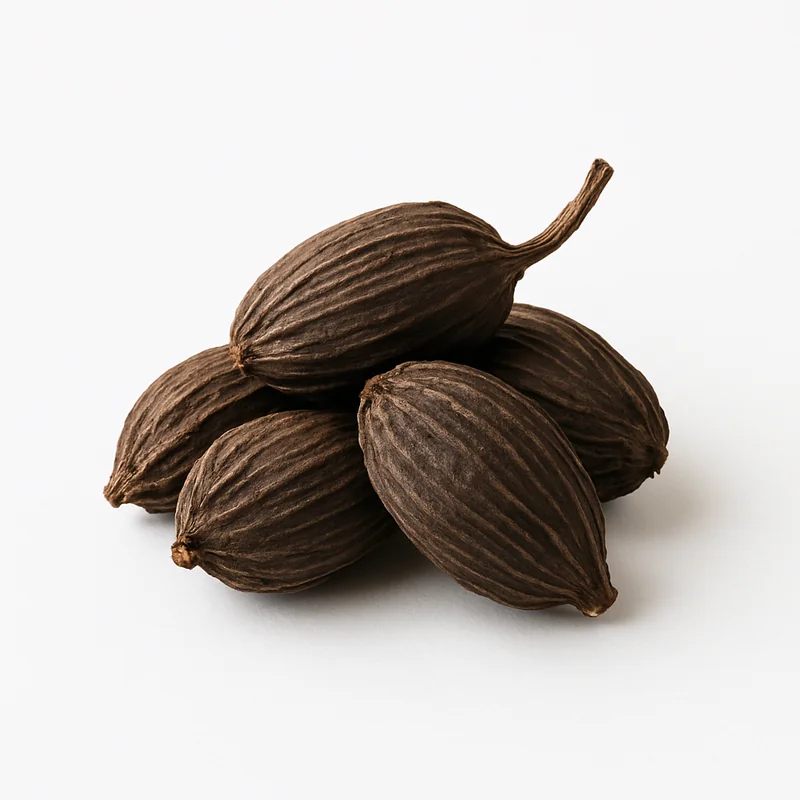
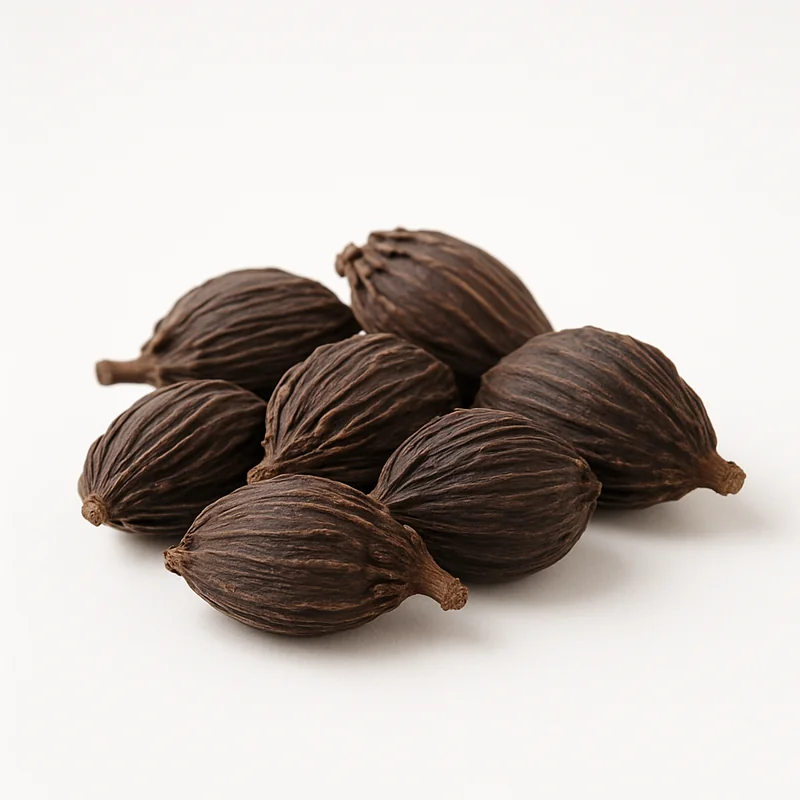
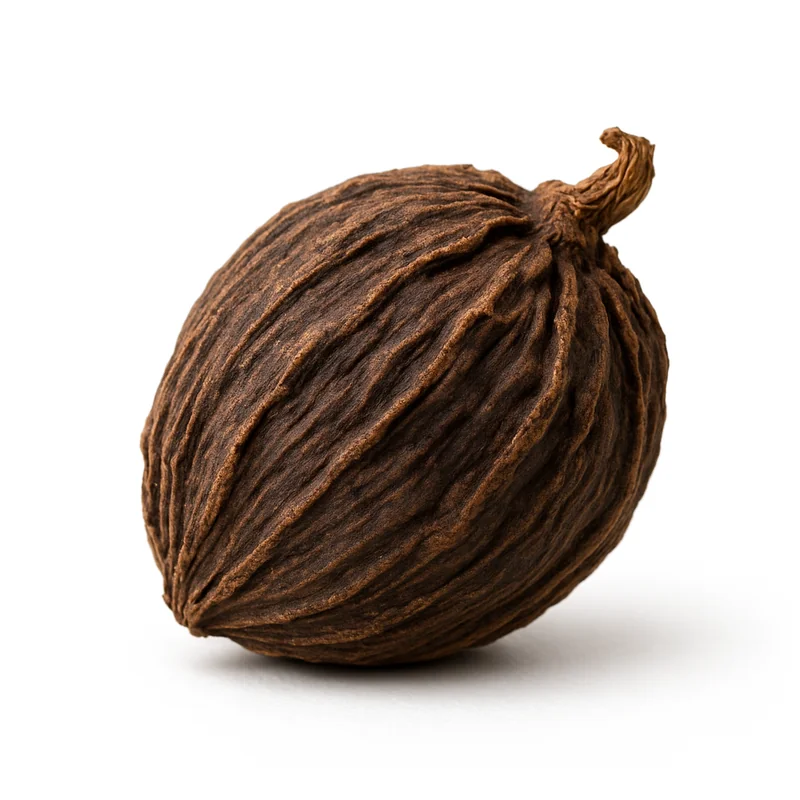
Black Cardamom — image 1 of 3Black Cardamom — image 2 of 3Black Cardamom — image 3 of 3
Herbs & Spices

Black Cardamom

97/ 100
Also known as: amomum subulatum, brown cardamom, smoked cardamom, badi elaichi

Black cardamom is a large smoke-dried pod rich in 1,8-cineole, supporting digestion and offering antioxidant and antimicrobial benefits.

Nutrition · per ~2 g serving · ≈ a pinch

🔥 Calories
6/ 2000 kcal day
🥩Protein0.2 g<1% DV
🍞Carbs1.4 g<1% DV
🥑Fat0.1 g<1% DV
🌿Fiber0.6 g2% DV
1g net carbs · carbs − fiber
Vitamins
  • Vitamin C0.42 mg<1% DV
  • Vitamin B60.00 mg<1% DV
  • Niacin0.02 mg<1% DV
Minerals
  • Manganese0.56 mg24% DV
  • Iron0.28 mg2% DV
  • Zinc0.15 mg1% DV
  • Magnesium4.6 mg1% DV
  • Copper0.01 mg<1% DV
  • Calcium7.7 mg<1% DV
  • Potassium22.4 mg<1% DV
  • Phosphorus3.6 mg<1% DV
  • Sodium0.36 mg<1% DV

Score · 97/100

Nutrient Density35.0 / 35

Vitamins & minerals packed in relative to calories — the single biggest driver of the score.

Protein Quality9.2 / 15

How much protein it delivers, by absolute grams and per calorie.

Fiber Content10.0 / 10

Dietary fiber for gut health, satiety and steadier blood sugar.

Healthy Fats5.0 / 10

Fat quality — unsaturated vs saturated, and trans-fat free.

Bioactives13.5 / 15

Polyphenols, flavonoids and other beneficial plant compounds for this food group.

Glycemic Impact10.0 / 10

Low sugar with a high fiber-to-carb ratio scores best — gentler on blood sugar.

Top Nutrients
  • Manganese1217% DV
  • Iron78% DV
  • Zinc68% DV
  • Magnesium55% DV
  • Copper42% DV

Overview

Black cardamom (Amomum subulatum), distinct from the smaller green cardamom, is a large pod traditionally dried over open fires that gives it a resinous, smoky, camphor-like aroma. Its volatile oil is dominated by 1,8-cineole (eucalyptol), accompanied by terpinene and limonene—monoterpenes with antioxidant, antimicrobial, and respiratory-soothing properties. Estimated conservatively at about 311 kcal per 100g, the dried pods are mineral-dense, supplying roughly 28 mg manganese, 14 mg iron, 229 mg magnesium, and over 1,100 mg potassium per 100g, plus notable zinc. Mechanistically, cineole acts as a mucolytic and bronchodilator while exerting anti-inflammatory effects on respiratory tissue, and the broader terpene profile contributes free-radical scavenging and digestive stimulation. In Indian cuisine black cardamom anchors savory garam masala and slow-cooked dishes, where its smoky depth differs sharply from green cardamom's sweet floral note. Used whole and removed before serving, it infuses dishes with both flavor and its bioactive volatile oils.

Health Benefits (3)

  • Supports respiratory comfort
    moderate
    1,8-cineole acts as a mucolytic and mild bronchodilator while reducing airway inflammation
  • Aids digestion
    limited
    Aromatic terpenes stimulate digestive secretions and relieve gas and bloating
  • Provides antioxidant and antimicrobial activity
    moderate
    Cineole, terpinene, and limonene scavenge free radicals and inhibit microbial growth

Food Pairings

  • ·Pair with cumin and coriander in savory spice blends because their warming aromatics complement cardamom's smoky depth
  • ·Combine with slow-cooked legumes and meats because prolonged simmering releases its fat-soluble terpenes

Practical Tips

  • ·Lightly crush the pod before adding to release the volatile oils, then remove before serving
  • ·Toast briefly in dry heat or oil to bloom the cineole-rich aroma

Optimal Timing

🕒
anytime
Fasting-compatible

Black cardamom is a culinary spice with no circadian dependency.

Negligible calories per culinary serving; compatible with fasting.

Systems supported

body systems this food feeds

Pathways supported

biochemical reactions enabled by this food