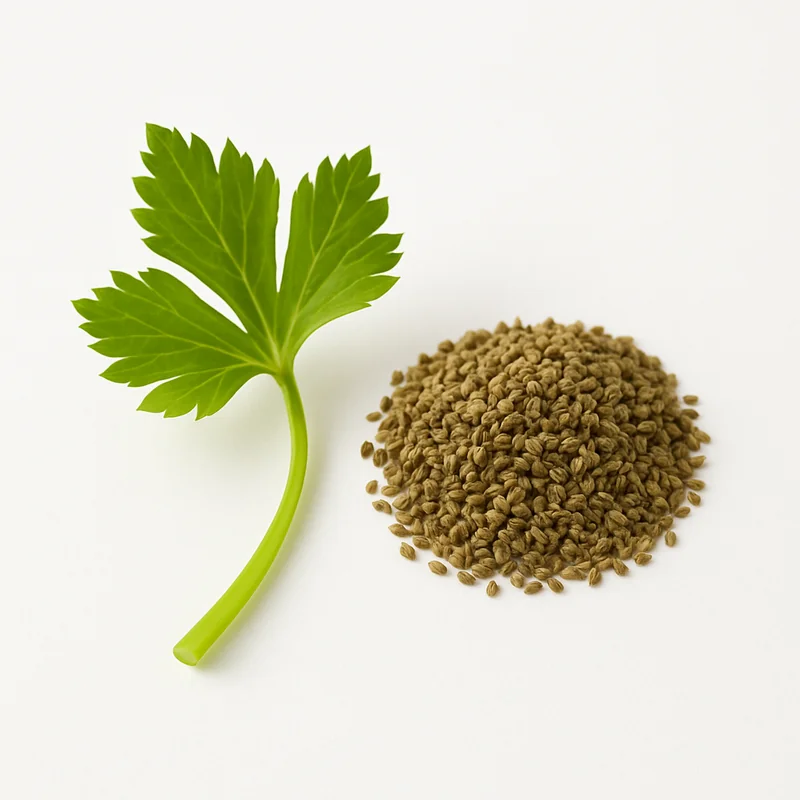
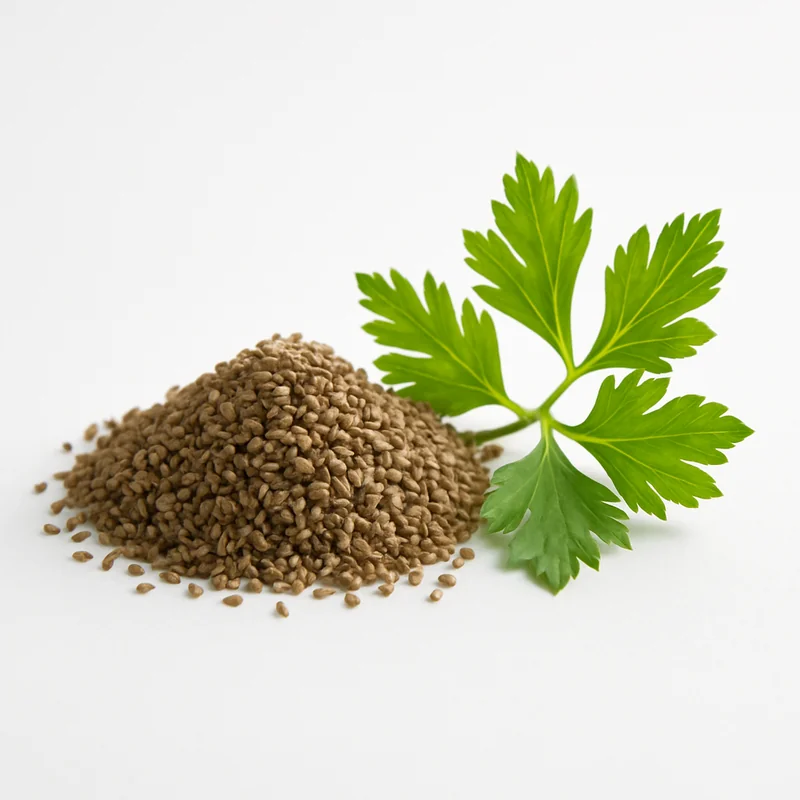
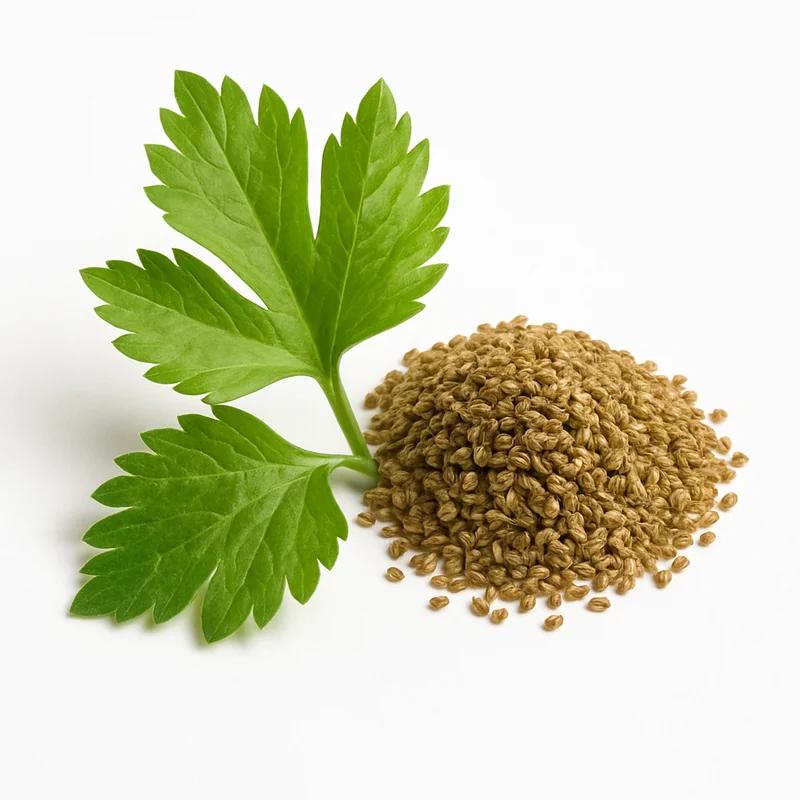
Celery Seed — image 1 of 3Celery Seed — image 2 of 3Celery Seed — image 3 of 3
Herbs & Spices

Celery Seed

97/ 100
Also known as: apium graveolens, smallage seed

Celery seed is the tiny, intensely flavored fruit of Apium graveolens, an extraordinarily calcium- and iron-rich spice traditionally used for gout and hypertension via blood-pressure-lowering phthalides.

Nutrition · per ~2 g serving · ≈ a pinch

🔥 Calories
8/ 2000 kcal day
🥩Protein0.4 g<1% DV
🍞Carbs0.8 g<1% DV
🥑Fat0.5 g<1% DV
🌿Fiber0.2 g<1% DV
1g net carbs · carbs − fiber
Vitamins
  • Vitamin B60.02 mg1% DV
  • Thiamin0.01 mg<1% DV
  • Riboflavin0.01 mg<1% DV
  • Niacin0.06 mg<1% DV
  • Vitamin C0.34 mg<1% DV
  • Folate0.20 mcg<1% DV
  • Vitamin A1.0 iu<1% DV
Minerals
  • Manganese0.15 mg7% DV
  • Iron0.90 mg5% DV
  • Copper0.03 mg3% DV
  • Calcium35.3 mg3% DV
  • Magnesium8.8 mg2% DV
  • Zinc0.14 mg1% DV
  • Phosphorus10.9 mg<1% DV
  • Potassium28.0 mg<1% DV
  • Selenium0.24 mcg<1% DV
  • Sodium3.2 mg<1% DV
BioactivesEstimated
  • Polyphenols~3.0 mg
Estimated typical amounts — derived from this food's profile, not measured for this item. Real bioactive content varies widely by variety, ripeness, storage and preparation; use as a rough guide only.
Source: USDA SR Legacy · 170915

Score · 97/100

Nutrient Density35.0 / 35

Vitamins & minerals packed in relative to calories — the single biggest driver of the score.

Protein Quality11.4 / 15

How much protein it delivers, by absolute grams and per calorie.

Fiber Content10.0 / 10

Dietary fiber for gut health, satiety and steadier blood sugar.

Healthy Fats7.5 / 10

Fat quality — unsaturated vs saturated, and trans-fat free.

Bioactives13.5 / 15

Polyphenols, flavonoids and other beneficial plant compounds for this food group.

Glycemic Impact10.0 / 10

Low sugar with a high fiber-to-carb ratio scores best — gentler on blood sugar.

Top Nutrients
  • Manganese329% DV
  • Iron249% DV
  • Copper152% DV
  • Calcium136% DV
  • Magnesium105% DV

Overview

Celery seed (Apium graveolens) is the minuscule, dark-brown fruit of a wild seed-bearing variety of the same species as stalk celery. Each seed is barely larger than a grain of sand yet carries an intense, concentrated celery flavor with a warm, slightly bitter edge from phthalides such as 3-n-butylphthalide. It is among the most mineral-dense spices known, supplying about 1767mg of calcium, 44.9mg of iron, 440mg of magnesium, and 7.6mg of manganese per 100g, with naturally elevated sodium for a seed. The spice is best known in celery salt, the classic seasoning for a Bloody Mary and Chicago-style hot dog, and in pickling brines, coleslaw, and dry rubs. Celery seed has a long folk-medicine record for gout, arthritis, and high blood pressure: its phthalides relax vascular smooth muscle with blood-pressure-lowering and vasorelaxant effects in animal and small human studies, while its mild diuretic action and the antioxidant flavone apigenin support traditional uses for fluid retention and inflammation. Because celery is a common allergen, sensitive individuals should use caution. For longevity-focused cooking, celery seed concentrates celery's flavor and an exceptional mineral load into a tiny, potent seed.

Health Benefits (4)

  • Supports healthy blood pressure
    emerging
    Phthalides, notably 3-n-butylphthalide, relax vascular smooth muscle, producing vasorelaxant and blood-pressure-lowering effects in animal and small human studies
  • Provides anti-inflammatory and antioxidant activity
    moderate
    The flavones apigenin and luteolin scavenge free radicals and inhibit inflammatory signaling, the basis for traditional use in gout and arthritis
  • Acts as a mild diuretic
    emerging
    Celery seed compounds promote modest fluid excretion, underlying its folk use for water retention
  • Delivers exceptional calcium, iron, and manganese
    strong
    Among the most mineral-dense spices, supplying calcium (1767mg), iron (44.9mg), and manganese (7.6mg) per 100g for bone health and oxygen transport

Food Pairings

  • ·Blend with salt to make celery salt for tomato-based drinks, hot dogs, and seafood boils
  • ·Pair with vitamin C-rich tomato and citrus because ascorbate enhances absorption of celery seed's abundant non-heme iron
  • ·Use in vinegar-based pickling brines and coleslaw because acidity carries and brightens its concentrated celery flavor
  • ·Combine with cabbage and potato because the warm, savory seed deepens vegetable dishes when fresh celery is unavailable

Practical Tips

  • ·Use celery seed sparingly; it is potent and turns bitter if overused
  • ·Make fresh celery salt by grinding the seeds with coarse salt for a brighter flavor than store-bought
  • ·Note that celery is a common allergen and the seed can be photosensitizing in very large amounts
  • ·Buy whole seeds; they retain their potent oils for 3-4 years versus much less for ground celery seed
  • ·Store in an airtight container away from heat, light, and moisture to prevent clumping

Optimal Timing

🕒
anytime
Fasting-compatible

Celery seed is a seasoning with no circadian dependency; its minerals and bioactives benefit any meal it flavors.

Used by the pinch it adds negligible calories and does not break a fast.

Systems supported

body systems this food feeds

Pathways supported

biochemical reactions enabled by this food